How to Start Digital Marketing: A Complete Beginner’s Guide
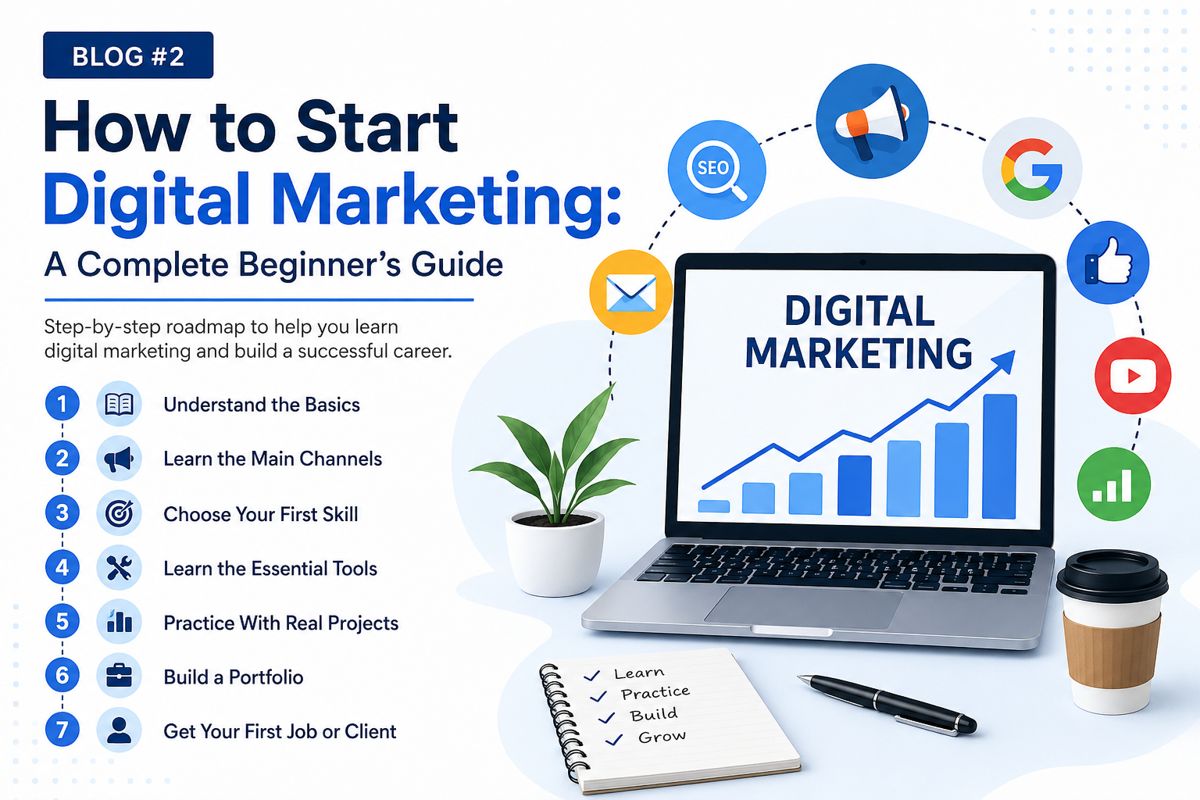
Want to start digital marketing but have no idea where to begin? You’re not alone. You may have seen people talking about SEO, Instagram marketing, Google Ads, content marketing, email marketing, analytics, and AI tools and wondered: “Do I need to learn all of this?” The short answer is no. You don't need to become an expert in every area before getting started. Digital marketing is a collection of different skills, and you can learn them step by step through practice. You can learn digital marketing by yourself, with or without a degree, and you don't need to know how to code to begin. In this guide, we'll walk through exactly how to start digital marketing in 2026, what to learn first, which tools to use, how to gain practical experience, and how to move toward your first job or freelance client.
Can Anyone Start Digital Marketing?
Yes. Digital marketing is not limited to people with marketing degrees or computer science backgrounds. Students, graduates, business owners, designers, content creators, freelancers, and career changers can all learn digital marketing.
What matters more than your educational background is your ability to understand an audience, create useful content, communicate clearly, analyse results, learn new tools, test different strategies, and adapt when something doesn't work.
The digital marketing landscape changes constantly. Platforms introduce new features, algorithms change, AI tools evolve, and consumer behaviour shifts. So being willing to learn, test, and improve is one of the most valuable skills you can develop.
Step 1: Understand the Basics of Digital Marketing
Before opening an Ads Manager account or trying to rank a website on Google, understand what digital marketing actually does. At its simplest, digital marketing is about using digital channels to connect a business with potential customers.
Think about a typical customer journey: Discover → Explore → Trust → Act → Return. Someone sees an Instagram Reel from a clothing brand. They visit the brand's profile. They check the products. They visit the website. They compare products and reviews. Finally, they place an order.
Different digital marketing channels can influence different parts of this journey. So before learning individual tools, understand concepts such as target audience, customer journey, buyer intent, branding, content, conversion, leads, sales, website traffic, engagement, and analytics.
Once these concepts make sense, the individual marketing channels become much easier to understand.
Step 2: Learn the Main Digital Marketing Channels
Digital marketing is not one single skill. It is more like a toolbox, and each tool has a different purpose. Here are the major areas you should know about.
1. Search Engine Optimization (SEO)
SEO helps websites appear organically in search engine results. You may learn keyword research, search intent, on-page SEO, technical SEO basics, content optimization, internal linking, backlinks, and SEO analytics.
For example, if someone searches “best digital marketing course for beginners”, SEO helps a relevant website appear in those results.
3. Paid Advertising
Paid advertising allows businesses to reach specific audiences through advertising platforms such as Meta Ads, Google Ads, YouTube Ads and LinkedIn Ads.
You'll eventually need to understand campaign objectives, targeting, audiences, ad creatives, budgets, bidding, landing pages, conversion tracking, cost per click, cost per lead, and return on ad spend. Don't try to master everything on day one — start with the fundamentals.
4. Content Marketing
Content marketing focuses on creating useful content that attracts and helps a target audience: blog posts, videos, Reels, guides, social media posts, infographics, case studies and newsletters.
A good digital marketer doesn't simply ask “What can I post?” They ask “What does my audience need to know?” That small change in thinking can make a huge difference.
5. Email Marketing
Email marketing helps businesses communicate directly with their audience. You can learn email campaigns, newsletters, lead magnets, segmentation, automation, open rates, click-through rates and conversion tracking.
Email is particularly useful for businesses that want to build long-term relationships with customers.
6. Analytics and Conversion Optimization
Getting traffic is not enough. You also need to understand what visitors do after they arrive. Analytics helps answer questions like: where are visitors coming from, which pages do they visit, which campaigns generate leads, where are people dropping off, which content performs best, and how many visitors become customers?
This is where data starts turning marketing from guesswork into decision-making.
Step 3: Choose Your First Skill
This is where many beginners make a mistake. They try to learn SEO, Meta Ads, Google Ads, email marketing, content, web development and analytics at the same time. The result is information overload.
Instead, choose one primary skill to learn deeply first. If you enjoy creativity, start with social media marketing and content creation. If you enjoy writing and research, start with SEO and content marketing. If you enjoy numbers and testing, start with paid advertising and analytics. If you enjoy communication, start with social media and community management. If you enjoy websites and technical problem-solving, start with SEO and analytics.
You can expand your skill set later. A strong digital marketer eventually understands how the different channels work together, but you don't have to learn the entire digital marketing universe before taking your first step.
Step 4: Learn the Essential Tools
Once you understand the concepts, start becoming comfortable with the tools used to execute digital marketing. You don't need dozens of platforms — start with a small toolkit.
For content and design: Canva and Adobe Express. For website analytics: Google Analytics and Google Search Console. For advertising: Meta Ads Manager and Google Ads. For SEO: Google Keyword Planner, Search Console and an SEO research tool. For websites: WordPress or a basic website builder. For planning: Google Sheets and Notion. For AI-assisted work: AI writing, image and research tools.
The important thing isn't simply knowing where to click. You need to understand why you're using the tool and what the data means.
Step 5: Practice With a Real Project
This is probably the most important step. Don't spend six months only watching tutorials — create something.
You could start a small Instagram page, create a simple blog, build a website for a fictional business, help a friend's business, create a mock advertising campaign, start a niche content page, promote your own service, or optimise a small website for search.
For example, imagine you choose a fictional café. You could create an Instagram strategy, 10 posts, 5 Reels, a content calendar, a simple website, SEO keywords, a Meta Ads mock campaign and an analytics report.
Suddenly, you aren't just saying “I know digital marketing.” You can show what you planned, what you created, what you tested, and what you learned. That difference matters.
Step 6: Build a Portfolio
You don't need ten years of experience to build a portfolio. You need evidence that you can do the work.
Project 2: SEO Project
Show the website, keyword research, search intent, on-page improvements and content plan.
Project 3: Paid Advertising Project
Show the campaign objective, audience, creative concepts, budget, landing page and key metrics.
Project 4: Content Marketing Project
Show topic research, blog strategy, content calendar, published articles and performance data. Even personal projects can demonstrate your ability. Your portfolio doesn't have to scream “I am an expert.” It should quietly prove “I know how to do the work.”
Step 7: Get Your First Digital Marketing Job or Client
Once you have basic knowledge and a few projects, start looking for opportunities: digital marketing agencies, in-house marketing teams, startups, e-commerce businesses, local businesses, internships, freelance platforms, professional networks and direct outreach.
For your first opportunity, don't focus only on the job title. Look for opportunities where you can actually do marketing work. You might start as a Digital Marketing Intern, Social Media Executive, SEO Executive, Content Marketing Intern, PPC/Ads Executive, Marketing Assistant or Digital Marketing Executive.
Your first role is less about having the perfect title and more about getting your hands dirty with real campaigns, content, websites, audiences and data.
Can You Start Freelancing as a Beginner?
Yes — but there's an important distinction. You can start freelancing as a beginner, but you shouldn't pretend to have expertise you don't have. Start small.
Instead of offering “I do everything in digital marketing,” you could offer “I help local businesses create and manage Instagram content,” or “I create SEO-friendly blog content for small businesses,” or “I help small businesses set up and manage basic social media campaigns.”
A focused service is easier to learn, sell and deliver. As your skills grow, you can expand your services.
How Long Does It Take to Learn Digital Marketing?
There is no single answer. Digital marketing isn't something you completely “finish learning.” You can learn the fundamentals relatively quickly, but becoming highly skilled takes much longer because you need real-world experience.
Month 1 — Foundations: digital marketing basics, audience research, customer journey, content fundamentals, major marketing channels and basic analytics.
Month 2 — Skill development: choose one primary area and practise it. For example SEO (keywords → content → on-page → Search Console), social media (content strategy → design → Reels → analytics), or paid ads (campaign structure → audiences → creatives → metrics).
Month 3 — Practical experience: create projects, build your portfolio, analyse results, improve your work, and start applying for internships, jobs or freelance opportunities.
After three months you may not be an expert, but you can have something much more valuable than another collection of saved tutorials: a foundation, practical skills and portfolio projects.
Can I Learn Digital Marketing in 3 Months?
Yes, you can learn the fundamentals in three months. But don't confuse learning the basics with mastering digital marketing.
Three months can be enough to understand the major concepts, learn one or two practical skills, use essential tools, create projects and start applying for entry-level opportunities. It isn't enough to guarantee expertise. Think of the three months as building the runway, not completing the entire flight.
The best approach is a repeating cycle: learn, practise, build, measure, improve.
Do You Need a Degree to Start Digital Marketing?
No, a specific degree is not required to begin learning digital marketing. A degree can be useful for some jobs and organisations, but digital marketing is also a practical field where demonstrable skills and experience matter.
Employers and clients may want to see what you can create, whether you understand an audience, whether you can analyse campaign performance, write good content, manage social media, generate leads, explain your strategy and use relevant tools. Your portfolio can help answer these questions.
So if you don't have a marketing degree, don't treat that as a reason to stop. Build skills. Build projects. Build evidence.
Do You Need Coding Skills for Digital Marketing?
No, coding is not a requirement for starting digital marketing. You can work in social media marketing, content marketing, SEO, email marketing, paid advertising, influencer marketing and marketing strategy without becoming a programmer.
However, learning some basic HTML, CSS, website structure, tracking concepts and technical SEO can become useful as you progress. Think of coding as a bonus skill, not an entry ticket.
What Digital Marketing Skills Should You Learn?
Core skills: digital marketing fundamentals, audience research, content creation, copywriting, social media marketing, SEO basics, paid advertising basics, analytics and communication.
Technical skills: Google Analytics, Google Search Console, Meta Ads Manager, Google Ads, WordPress, Canva and spreadsheet basics.
Strategic skills: campaign planning, competitor research, customer journey mapping, marketing funnels, KPI selection and performance analysis.
Human skills: creativity, curiosity, problem-solving, communication, time management, adaptability and critical thinking. Tools can help you execute; your thinking determines what you execute.
A Simple 90-Day Digital Marketing Roadmap
Days 1–15: learn digital marketing fundamentals and the major channels. Days 16–30: content and social media — create a sample content strategy. Days 31–45: SEO basics — research keywords and optimise content. Days 46–60: paid advertising basics — build a mock campaign. Days 61–75: analytics — learn how to measure performance. Days 76–90: portfolio building — create 2–3 complete projects.
By the end of those 90 days, your goal shouldn't be “I know everything about digital marketing.” It should be “I understand the fundamentals, I can use important tools, and I can demonstrate what I know through practical projects.” That's a much more useful destination.
Common Mistakes Beginners Should Avoid
Trying to learn everything. You don't need to master every marketing channel immediately — start with one.
Watching tutorials without practising. Ten hours of tutorials won't automatically give you ten hours of experience.
Collecting certificates instead of skills. Certificates can support your profile, but they aren't a substitute for practical ability.
Copying other marketers blindly. A strategy that works for one business may fail for another — learn the reasoning behind it.
Ignoring analytics. Likes and followers aren't the entire story; connect marketing activity to business outcomes.
Being afraid of starting small. A local business, personal page or practice project can teach you a lot.
Final Thoughts: Start Before You Feel Ready
The biggest challenge in learning digital marketing isn't usually finding information — there's plenty of it. The challenge is turning information into ability.
You don't need to know SEO, Meta Ads, Google Ads, content marketing, analytics, email marketing and every new AI tool before you start. Start with the fundamentals. Choose one skill. Learn the tools. Build a real project. Measure what happens. Improve it. Then build another.
That's how digital marketing starts becoming more than something you watch tutorials about — it becomes something you can actually do.
Suggested Next Reads
What Is Digital Marketing?
Start here if you are brand new to digital marketing.
Digital Marketing Services
See the SEO, Meta Ads, social media and design services I offer.
Portfolio & Work
Real projects and campaign work from my portfolio.
Contact Me
Questions about starting out? Message me on WhatsApp or email.
Frequently Asked Questions
Can I learn digital marketing by myself?+
Yes. Plenty of online resources, courses and tutorials exist. Self-learning works best when you combine learning with real projects rather than consuming content passively.
Is digital marketing difficult for beginners?+
The basics are accessible, but there are many areas to learn. The easiest way to avoid feeling overwhelmed is to learn one skill at a time.
What should I learn first in digital marketing?+
Start with fundamentals, audience research, content, customer journeys and the major channels. Then choose one area to practise more deeply.
Can I learn digital marketing without spending money?+
Yes. You can learn the fundamentals with free resources and practise using free or free-tier tools. You don't need an expensive setup to begin.
Do I need a laptop?+
A laptop is highly useful for analytics, websites, SEO research, ad platforms and reporting. Some beginner social media and content work can be started with a smartphone.
Can I get a digital marketing job after three months?+
You can start applying for internships and entry-level roles after building foundational knowledge and practical projects. Getting hired depends on your skills, portfolio, communication and the role.
Can I freelance without experience?+
Yes, but start with services you can genuinely deliver. Build sample projects first if you don't yet have client work.
Which digital marketing skill is best?+
There is no single best skill. The best starting skill is often the one that matches your interests while also having demand in the market.
Need help growing your business?
I'm Muhammed Sanal — a freelance digital marketer in Thalassery helping brands grow with SEO, Meta Ads, and social media.

Comments
Comments are moderated. Have thoughts on this article? Message me on WhatsApp or email — I read every one.
2. Social Media Marketing
Social media marketing involves using platforms such as Instagram, Facebook, LinkedIn and YouTube to build awareness, engagement, traffic, leads, or sales. You'll learn content strategy, social media calendars, Reels and short-form content, captions, hashtags and discoverability, community engagement, analytics, and organic growth.
This is often one of the easiest areas for beginners to start practising because you can create and publish content without needing a large budget.